

Highlights from this article
- Network redundancy is most effective when backup infrastructure removes the same points of failure as the primary path.
- Resilient network design considers connections, equipment, power and dependencies across the full network, not just the internet service.
- Distributed operations need resilience designed around the critical systems, connectivity options and operational requirements of each location.
For organisations operating across multiple, regional or remote sites, network resilience comes down to what happens when part of the infrastructure fails: which operations are affected, how traffic responds and which critical systems remain available.
In this InfoByte:
Network resilience, redundancy and failover
Network resilience describes the ability of a network to continue supporting required operations when part of its infrastructure is disrupted.
The National Institute of Standards and Technology (NIST) describes network resilience as the ability to continue operating through disruption and recover normal operations after a failure.
Redundancy and failover are two of the mechanisms used to achieve it.
Network redundancy
Alternative connections, equipment or pathways that prevent a single failure from interrupting critical services.
Network failover
Shifts traffic or services to an alternative path when the primary connection or component fails. This may use a secondary WAN service, another carrier or 4G/5G.
For business continuity, having a secondary connection is not enough if both paths share the same point of failure.
Resilience also differs from disaster recovery. Resilient infrastructure is designed to maintain critical services during a failure, while disaster recovery focuses on restoring them after disruption.

Designing out single points of failure
A resilient network starts with understanding what can fail and what happens next.
Two internet providers can look like redundancy on paper. But if both connections enter the site through the same physical route, rely on shared upstream infrastructure or terminate on the same edge device, one failure can still take both paths offline.
Single points of failure can also include:
- routers, switches and firewalls
- WAN and internet connections
- carrier infrastructure and physical cable routes
- power supplies and supporting infrastructure
- network services relied on by multiple locations
- equipment through which both primary and backup paths pass
The objective is not to duplicate every component. Resilient network design identifies infrastructure whose failure would have an unacceptable operational consequence, then determines where redundancy or an alternative path is justified.
A secondary connection only improves resilience when it doesn’t share the same critical points of failure.
Redundancy and resilience are closely related, but they describe different aspects of network design. This short Vology video provides a useful explanation of that distinction from a physical infrastructure perspective:
Designing resilience across distributed operations
A metropolitan office, regional facility and remote operational site can be equally important to the business, but the connectivity options and failure risks at each may be very different.
This is common across agriculture, mining and industrial operations, where networks can support everything from business applications to sensors, cameras, IoT devices and automated equipment.
Resilience therefore needs to account for each location:
- What needs to stay connected? Identify the systems and services that operations depend on.
- How much disruption can the site tolerate? A critical operational system may require a different approach to a non-essential service.
- What independent connections are available? This could mean separate fixed WAN services, different carriers or 4G/5G as a secondary path.
- Does the backup remove the original risk? An alternative connection is only useful if it provides genuine diversity where it is needed.
For larger multi-site networks, SD-WAN can help manage multiple connections and control how traffic is routed when conditions change or a link fails. It can support resilience, but the underlying connections, dependencies and failover configuration still determine how the network responds.
Network architecture needs to reflect the requirements and constraints of each location. Quo Group’s Infrastructure & Network Solutions include custom networks, WANs and connectivity solutions for geographically dispersed and difficult-to-access sites.
A resilient design gives critical traffic another viable path when the preferred connection becomes unavailable. The diagram below shows how that can work at a distributed site.
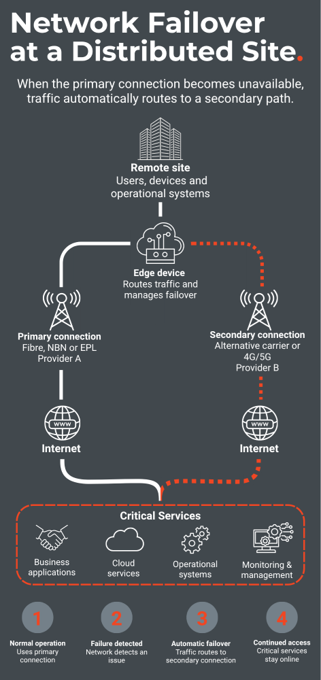
Distributed network resilience depends on each site’s design and the shared infrastructure connecting them.
Five components of a resilient distributed network
While network architecture will differ between organisations and locations, five areas provide a useful framework for assessing resilience.
- Diverse connectivity paths
Different carriers or connection types don’t always mean independent infrastructure. Where continuity is critical, confirm that primary and secondary paths don’t share the same points of failure. - Redundancy at critical points
Focus redundancy where failure would disrupt critical operations, including key network devices, power, WAN connections and shared services. - Automatic and tested failover
Backup connectivity needs a defined failover process. Test it under realistic conditions to confirm traffic, applications and critical services continue operating as intended. - Network-wide visibility and monitoring
Monitoring across sites and connections helps identify degradation and failures, while providing visibility into how the network responds during an incident. - Architecture aligned with operations
Redundancy should reflect the operational impact of a failure. Design around operational impact, critical systems and how long each location can tolerate lost connectivity.
Network Resilience Check
Use these six questions as a quick assessment of your current network environment.
1. Have critical single points of failure been identified?
2. Are primary and secondary connections genuinely independent?
3. Can critical traffic automatically fail over to a secondary path?
4. Has failover been tested under realistic conditions?
5. Can critical systems continue operating if a site, connection or network component fails?
6. Do you have visibility across critical sites and network paths?
Your network appears to have key resilience measures in place. Continue testing failover and reviewing the design as sites, systems and dependencies change.
For complex or distributed environments, Quo Group can assess network resilience and design network infrastructure around the operational and connectivity requirements of each location.